
How to Use Diatonic Scales to Break Free of Your Writer's Block

Do your solos keep sounding the same? Does it feel like your hands always find the same riffs, the same patterns, the same notes, no matter what you're playing over?
You're not stuck because you lack talent. You're stuck because you're working with a limited map.
The good news? Adding just two notes can completely change where you go.
What Are Diatonic Scales (Quick Refresher)?
If you already know the pentatonic scale, you're already most of the way there. The diatonic scale — also called the major or natural minor scale depending on the key — is simply the pentatonic with two additional notes added in. Those two notes are what give it that fuller, more melodic sound. They're the notes that make melodies sing rather than just speak.
Think of the pentatonic as your comfort zone and the diatonic as the room just beyond it. Everything you know still works, you're just giving yourself more to explore.
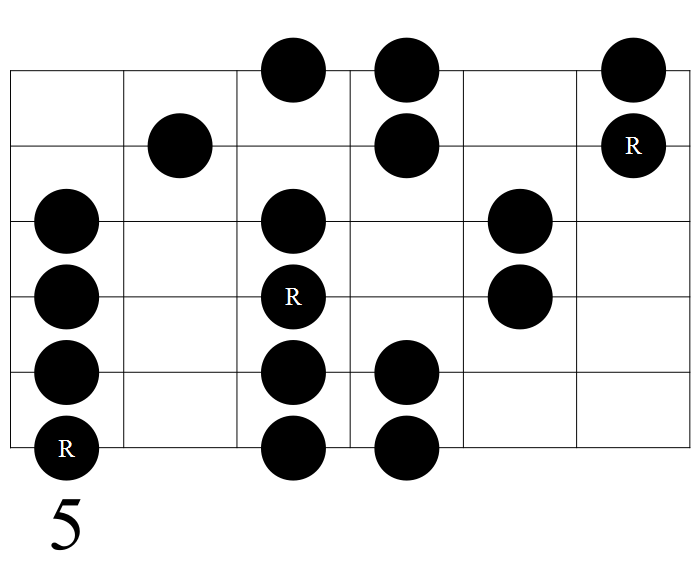
Here’s a diagram of a 3 note-per-string shape that overlaps nicely with the 1st pentatonic box in the same position.
1. Create More Expressive Solos
Here's something worth considering: you don't have to shred to play a memorable solo. In fact, some of the most iconic guitar solos in rock history are built on simple, singable melodies, not speed or technique.
Take "Don't Stop Believin'" by Journey. The guitar solo isn't a flurry of fast notes. It's essentially the chorus melody, reworked for the guitar. One clear idea, a couple of variations, and it's done. That's all it takes.
The diatonic scale gives you the tools to do exactly this. Because it contains more notes than the pentatonic, it can express emotions: tension, longing, brightness, resolution, that the pentatonic simply doesn't reach on its own.
How to try it: Take a solo you've played before using your pentatonic box. Now, find the two extra notes that complete the diatonic scale in that key. Start weaving them in, just one at a time. Listen to how they shift the emotional color of the same phrases. Your goal isn't a new solo. It's a more expressive version of something you already play.
Write down what you notice. Which note felt like release? Which one added tension? These are your new building blocks.
2. Use Scales to Build Melodies Over Chord Progressions
This is one of the most freeing practices you can build as a guitarist. Here's why writer's block happens: your brain can only hum or imagine the melodies it already knows. The moment you sit down with a guitar, your hands follow your ear, and your ear follows familiar ground.
Scales break that loop.
Try this: Assign a number to each note in the diatonic scale (1 through 7). Then write a random sequence of those numbers — something like 1, 4, 3, 2, 2, 5 — and play those scale degrees in that order. Don't think. Don't judge. Just play the sequence and see what comes out.
Now you’ve come up with a completely new melody. Sometimes it may sound familiar, but sometimes, it may surprise you.
From there, try out different rhythms and add a few chords you feel go along with it — and just like that, a new idea is generated and writer's block is crushed. This process consistently produces melodic ideas you could never have heard in your head beforehand. That's the whole point.
3. Write Riffs by Breaking Out of Muscle Memory
If your riffs feel repetitive, it's often not a creativity problem — it's a physical habit problem. Your hands know where to go, and they go there automatically.
One of the fastest ways to break that pattern is to stop relying on feel and start using a little structure. The random-number approach described above works well here too.
But if you want your riff to feel more "centered" around the root — the way many rock and metal riffs do — simply insert the root note more frequently.
It can be random, or you can build patterns around it:
● Alternate between melody notes and the root note (play root after every other note): 1 3 1 2 1 4 …
● Group the notes in threes, and return to the root every third note: 331 231 …,
● Keep the root note constant and add melodic notes only on accents: 1 1 1 3 1 1 2 1 1 3 1 4 1…
Some of what you generate will be unusable. Some will surprise you. Occasionally, something unexpected will catch your ear and become the seed of a riff you'd never have found on your own.
You can also use this approach to deliberately visit notes you've been avoiding. If you notice you almost never land on the 6th or 7th scale degree in your playing, make a sequence that forces you there.
The unfamiliarity is the point: it's where new ideas live.
Start Small Tonight
You don't need to overhaul how you play. Just pick one of these three approaches and spend 10–15 minutes with it before your next practice session.
Learn where the two extra diatonic notes fall in a key you already know. Then use them to take one solo somewhere new, build one melody over a chord progression, or generate one riff from a random scale sequence.
That's it. One idea. One key. A little curiosity.
Writer's block doesn't survive contact with an open question.
Good luck!
About the Author
Janez Janežič is a songwriter and a guitar teacher from Slovenia. As a passionate creative, he loves teaching his local students in his učenje kitare v Novem mestu how to be creative and have fun with their instruments.